More About Unconscious Bias – A Guest Blog by John Luecke

Guest Blogger Intercultural Communications Trainer and Consultant John Luecke

About the Contributor: John Luecke, who serves as a long-time Raleigh Sister Cities volunteer with me, is an Intercultural Communication Trainer and Consultant. For more information: https://www.linkedin.com/in/jrluecke/

Introduction: Last month, I published a very widely read blog receiving a tremendous number of hits. In “Seven Biases in the Workplace – Let’s Be Brutally Honest About It,” I challenge us all to be brutally honest about unconscious biases that can pop into our heads about the diverse co-workers we interact with, and to address it with action. Admittedly, it was a fairly rudimentary blog introducing this concept.

Intercultural Communications Trainer and Consultant, John Luecke, with whom I serve as a Raleigh Sister Cities volunteer, agreed to write a guest blog going much deeper into this important issue. Thank you, John!

John writes: Last month’s blog post identified lots of typical workplace biases, but the solution is much more complicated than just becoming aware of them and then resisting the urge to enact your biases.

After all, unconscious biases are just that – unconscious. We’re generally not aware of them, thus making it hard to correct something we don’t see in ourselves. There are relatively objective ways of assessing our unconscious biases — the Implicit Attitude Test or IAT, for example. It’s a free, self-administered online test that helps identify unconscious bias. You can take the test here https://implicit.harvard.edu/implicit/

When I took it for potential biases toward black people and Muslims, the IAT told me that I had a “strong preference for white people.” A bit of a shock, but it didn’t call me a bigot or suggest I engaged in prejudicial actions against blacks, just that I preferred white people. Given my limited exposure to black people, this should not have been a surprise. I fared much better with Muslims, but then I’ve spent a lot of time studying Islam, Middle Eastern culture and have several Muslim friends.

For better or worse unconscious biases provide value; for example, they kept our ancestors alive when threatened by sabre tooth tigers or the warriors from the other side of the mountain. Today they continue to alert us to perceived threats and dangers.

Here’s how they work: When we see something as threatening, dangerous, or fearful our amygdala kicks in and floods our bodies with cortisol and testosterone – two hormones that allow us to quickly respond to dangers. The amygdala is a walnut-shaped structure that sits at the base of our brains and processes incoming signals. The result is a fight-flight or freeze response to danger, and it’s kept our species alive for thousands of years. The amygdala typically takes between 80 and 200 milliseconds to respond, and it shuts down our brain’s communication with our prefrontal cortex – that’s where reasonable thinking takes place.

If we can find a few seconds of stillness to let our prefrontal cortex become engaged, we can have a much more reasoned response to a perceived threat. However, if someone is coming after you with a big knife, go with the fight or flight response and let your prefrontal cortex sort things out later.

But for the kinds of perceptual threats we’re likely to encounter in the workplace – our biased reactions to the overweight employee, the millennial, the older employee — find that moment of stillness and let your reason take over from your amygdala.

Unconscious biases are part of the hard wiring of our brains. Incidentally, our brains consume approximately 20 percent of our bodies’ energy. By establishing unconscious biases, or brains conserve energy and make lots of automatic decisions. Some research suggests that up to 98 percent of what’s going on in our brains happens at an unconscious level. Problems occur when our brains make unconscious decisions about people, especially those decisions that disadvantage some people and prevent us from forming productive relationships with them.

There are lots of ways of dealing with unconscious bias beyond simply recognizing it in ourselves. One of the easiest is regular meditation – any kind of mediation. You don’t have to spend two years in a Tibetan cave, but 15 to 20 minutes a day of meditation can slow the response of your amygdala and provide time for your prefrontal cortex to engage. This includes such techniques as breath mediation, walking meditation, yoga, tai chi, qi gong, etc. Meditation is only one of the many tools we can use to reduce our unconscious biases.

Five Key Messages on The Importance of Out Gay Olympic Athletes

The two out 2018 American Olympians Gus Kenworthy (left) and Adam Rippon

NOTE: Links to additional blogs about out LGBT sports figures and issues are at the bottom of this blog.

The exciting 2018 Winter Olympics just concluded. As a huge figure skating fan and an adult skater myself, I spent way too many hours in front of the television this February. And as a diversity and career development consultant with a deep expertise in the LGBT (Lesbian, Gay, Bisexual, Transgender) workplace and marketplace, I was thrilled to see the positive coverage and celebration of our out gay Olympians.

Most notable among the American athletes were figure skater Adam Rippon, whose brilliant long program in the team event helped secure a bronze medal for the USA in the Team Figure Skating event, and skier Gus Kenworthy, who won a bronze medal at the 2014 Olympics and then a year later came out publicly as gay on the cover of ESPN magazine. And from Canada there is pairs skater Eric Radford who won the bronze medal with his skating partner Megan Duhamel.

So why is this important? I feel it sends five very important messages to struggling LGBT youth and others to boost them in their life journey. Here are the five:
1) Embrace who you are. It is important to feel positive and good about all the aspects of yourself that make you uniquely you. That is one of the important messages of diversity and inclusion – that each and every person in unique and we should each celebrate our own distinct combination of diversity attributes.

2) You are good – there is nothing wrong in being gay or queer. It so sad that some faith traditions, certain politicians and even some families propagate the lie that being queer is sinful, wrong or defective. This can destroy a young person who is struggling to find their place of belonging in the world. Our gay Olympic athletes showed us that they are wonderful good accomplished people fully enjoying their lives as well as their Olympic experience.

3) Don’t set limits – you can achieve and excel. These athletes, who are among the best in the world, did not buy into the lie that being gay was a defect that would hold them back from achieving great things. LGBT people can win gold medals, run companies, be accomplished musicians and actors. Queer kids, like anyone else, should feel free to pursue any career and hobby for which they have passion and talent, with no limits.

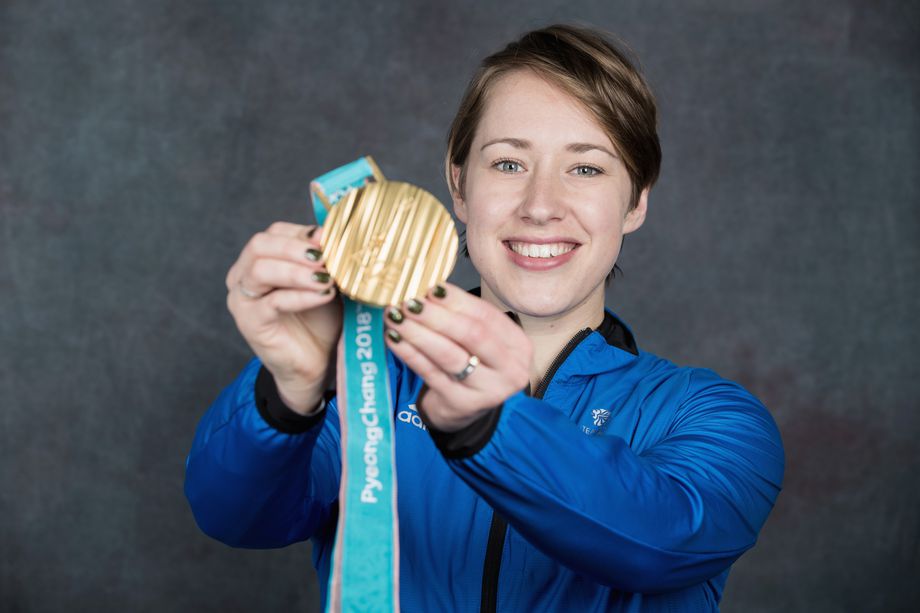
It is important to connect with positive supportive people like British Skeleton gold medalist Lizzy Yarnold, a straight ally who wore rainbow laces to show her support for LGBT atheletes.

4) Find and Focus on the supportive community. In addition to being embraced by the media (Adam Rippon became the media darling of the Olympics with his sparking, fun personality and poised interviews,) these gay athletes got their share of hateful nasty tweets and online posts. It is so very sad that there are still so many people who feel the need to judge others and put others down because they are different from them. Instead of getting thrown off by the haters, it is important to find and develop relationships with the supportive community. No one needs hate. Ignore and discard it.

5) Do what you can to share positivity with others. The infectious enthusiasm of the out gay athletes brought joy to their fans. Even Adam Rippon mentioned all the positive feedback he received with people struggling with their sexual orientation who were uplifted by Adam’s appearance at the Olympics and on television. By being who he is and expressing it with such elegance and positiveness, Adam profoundly helped so many others in their life journeys.

I do know of a few well meaning people who say, “why does this person need to be so public about being gay?” The answer: it is because it is who they are, and by fully embracing themselves, they empower others to celebrate their diversity, enjoy life to the fullest, and contribute their best to the human family.

* * * * *

See my other blogs about out gay figure skaters as well as other sports figures and issues:

Seven Fabulous “Out” Gay Men of Figure Skating

Seven More Fabulous Out Gay Men of Figure Skating (and One Bisexual Woman)

Russia, LGBT Rights and the Psychology of Bullying

Fortunate is the NFL Team that Drafts Out Gay Football Standout Michael Sam!

Football, Bullying and LGBT Diversity – The Good, The Bad and The Ugly.

Five Important Ramifications of NBA Pro Basketball Player Jason Collins’ Coming Out

# # # # #

Blog author Stan Kimer, in addition to training as an adult competitive figure skater himself, is a career development and diversity consultant with a deep expertise in corporate LGBT diversity strategy and training. Please explore the rest of my website (which includes my own figure skating page) and never hesitate to contact me to discuss diversity training for your organization, or pass my name onto your HR department.