
In this two part blog series, I am going to examine different perspectives of employees. The continued (and often exclusive) emphasis on short term earnings and current quarter results often and easily spreads into decisions around employee management and investment. The short term view of employees is that they are temporary resources that we engage to deliver a certain defined service. When that service is no longer needed, the employee is expendable. Employees are viewed as short term transactions.
This construct may certainly be valid for a subset of employees, especially if a business has large swings and is “large temporary project based.” Employees may be needed to simply fulfill a large non-recurring contract. However, there is a real need to view a significant part of the employee base as long term partners.
Long time employees who have strong loyalty to the enterprise serve many important roles. Often they are the ones who have a deep understanding of the entire enterprise and how everything works together within the company, and grown into general management roles. Other employees develop a strong expertise of industry dynamics and fulfill strategic planning and market planning roles. Others develop a deep relationship with the client base and are the sales leaders. And some become experts and senior advisors and specialists within a certain function of the company. In Part 2 I will explore the generalist vs specialist dynamic a little deeper.
Very importantly, enterprise organizational and employee development tools and processes need to address long term employee partnership as well as short term transactional skills. There is frequently a gap here. When I meet with clients, many have robust programs for employees to develop skills in their current jobs. Annual development plan reviews often focus on skills to enhance or improve current job performance. But are employees also engaged on discussions of five or ten year career growth?
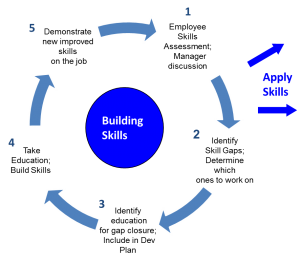
This is a typical short term skills building cycle, but a longer range career planning component needs to be added to employee development programs
Employee development processes need to have balance between the short term and long term and include a long range career growth component. That is what Total Engagement Consulting offers companies with our Career Road Mapping Services. We provide a construct and process for enterprises to offer employees long range career planning customized to their enterprise. This will increase employee engagement and productivity, retention and building long term employee loyalty and partnership.
Look for part 2 next week and also check out earlier blogs around career road mapping:
• Link: Introducing Career Road Mapping Services
• Link: The Business Case for Career Road Mapping / Skills Development
Also take my 11-question career road mapping / skills development quiz to see where your enterprise stands in the area.
