

Mother and Daughter Cathy and Rachel Swift are making an impact in their community through their involvement in theater.
In this next two-part blog, I am going to introduce a mother and a daughter who are both involved in the performing arts and having an impact on their communities in the United Kingdom. (Link to part 2 is at the bottom after the interview.)
I actually met the mother, Cathy Swift, on a hiking vacation in southern Spain. I traveled there from the US and Cathy from the UK, each traveling alone and joining about a dozen others in the arranged hiking tour. Cathy and I quickly hit it off, having similar past professional backgrounds in project management with large companies as well as a love for figure skating. Cathy actually helped push me into transitioning from a skating fan into an active participant (see my blog about finding a new passion in figure skating) and we have since attended a few figure skating camps together.

Cathy Swift and me at Dorothy Hamill’s adult skating camp in 2015
STAN: How did you get interested in the theatre?
CATHY: The first time I went to the theatre to see anything at all was at the age of 11, when my mum took me to see the D’Oyly Carte Opera Company perform The Mikado at Sadler’s Wells Theatre in London. I was mesmerised, especially by the Mikado’s long green fingernails, and the experience lead to a lifelong passion for Gilbert and Sullivan, and theatre generally. Twelve years later I set up a West London-based company called The Young Savoyards (named after the Savoy Theatre where the early G&S operettas were performed), for amateur performers under the age of 35 who wished to perform G&S. Since then I have set up two more amateur theatre companies. I set up Fysh 2 Fry Theatre Company in Bedford, where I used to live, and just a few months ago I set up AppEaling Theatre Company in Ealing, West London, where I now live.
STAN: What is something unique about your directing?
CATHY: This is a hard one. Having observed many people directing, I would say all directors have their own unique style. I guess one of the things I am passionate about is giving people a chance. I set up the Young Savoyards because I saw the established members of my previous group being cast all the time, regardless of ability, at the expense of talented youngsters. I would rather take risk on an actor who I think is really keen and has potential, than give a role to a ‘safe pair of hands’. I try very hard to be collaborative, and recognise the contributions made by every single team member – the set designer, the sound designer, the lighting designer and the costume designer are key, and are rightly given credit, but so are the people working behind the scenes in less glamorous roles, without whom there would literally be no show.
STAN: Are there certain issues in the theatre you are keen on addressing?
CATHY: Professional theatre in the UK is increasingly taking a ‘colour blind’ approach to casting. A good example is that my daughter, a professional British actress with very pale skin and red hair, was recently cast as the daughter of Black British actor Joseph Marcell. She will shortly be performing at Shakespeare’s Globe in a production of Much Ado About Nothing, and only four of the 12 cast members are white. But amateur theatre in the UK seems to remain the domain of the white middle class, and does not reflect the multicultural world in which we live. I would like to see this change.
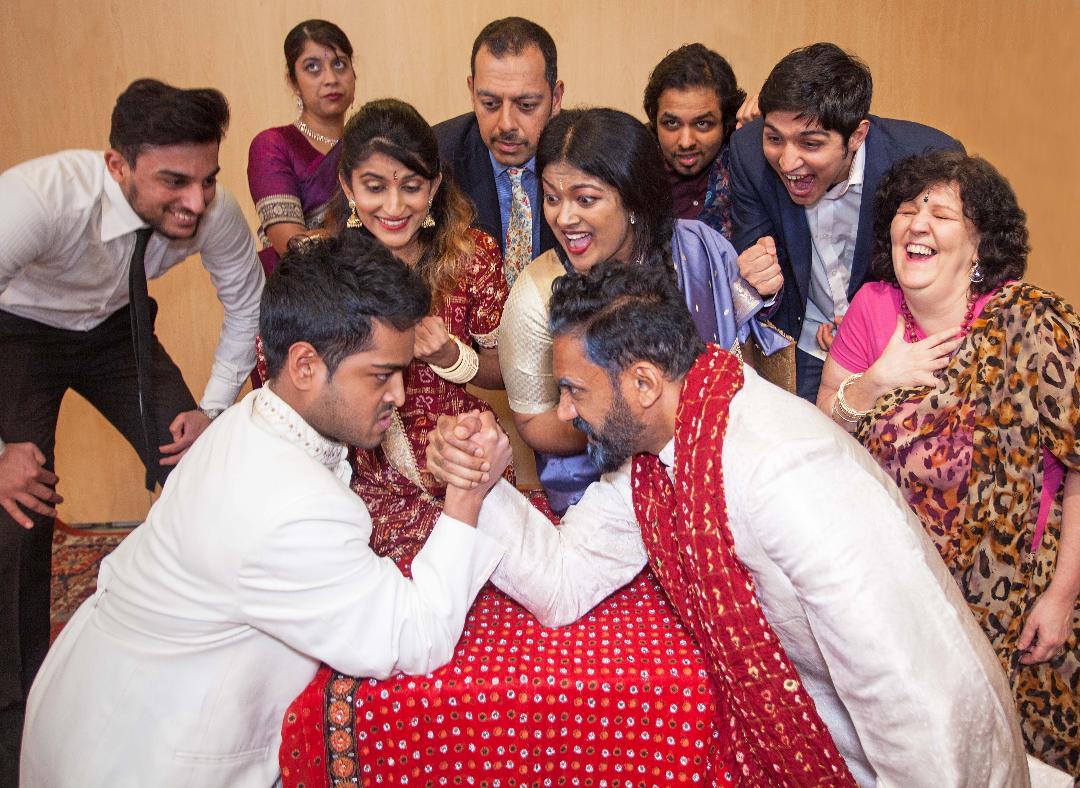
The Indian cast members of “Rafta Rafta” say that that the issues raised in the play are the same as those they have experienced in their own families.
CATHY: I am producing and directing Rafta, Rafta by Ayub Khan-Din (author of East is East) for amateur performance in May (2018.) This will be the first production of AppEaling Theatre Company. This wonderful play premiered at the National Theatre in 2007 and received rave reviews. Like East is East, it explores the challenges experienced by people from India as they try to settle in the UK, and the additional problems experienced within families by first- and second-generation Indians. It sounds serious – and it has some serious messages – but it a wonderfully funny play. My Indian cast members say that that the issues raised in the play are the same as those they have experienced in their own families. The only white cast member is someone who has, so far, only been given the chance to work backstage at our local theatre – I want to see her tread the boards wearing something other than her stage management ‘blacks’! I would like to see amateur theatre opened up to everyone.
STAN: Cathy, thank you for engaging with me about your theatre work; it would be great for one of my blog readers here in the USA to spearhead bringing you and Rafta Rafta over here to the USA. I even have one potential possibility myself. I now look forward to speaking to your daughter next.
CATHY: That would be amazing, Stan! Rachel is also looking forward to speaking with you!
 NOTE: Link For information about Rafta, Rafta at the AppEaling Theatre Company in Ealing, London, UK. Link for tickets.
Link to Part 2 about daughter Rachel.
* * * * *
My other blogs about social issues being addressed through the performing arts:
• “A great diversity experience – Theater Breaking Through Barriers” about enjoying an off-Broadway play in New York City which featured actors with a wide range of disabilities.
• “Promoting Diversity and Inclusion Through Bluegrass Music,” is about an innovative annual concert called “Shout and Shine” of diverse Bluegrass musicians. This celebration came about in 2016 as a direct response to North Carolina’s oppressive HB2 “bathroom bill” discriminating against our LGBT citizens.
• I introduce the Justice Theater Project, a social justice theater company whose mission is to produce compelling theater experiences that create community dialogue and give voice to social concern,s through my blog “The Justice Theater Project – Societal Impact Through the Performing Arts.”
• A follow on blog about the Justice Theater Project’s Play “Bent,” The Justice Theater Project presents “Bent” – a drama about Germany’s Third Reich’s persecution of homosexuals.

