
Part 3 of 3: The Diversity of Aging – Considerations and Issues in the Workplace

This blog concludes my three part series on the diversity of aging that I began in late June. In part one (link), I provided a general introduction to the topic of aging and shared some recent personal experiences that motivated me to write this series of blogs. In part 2 (link), I explored the intersection of LGBT (Lesbian, Gay, Bisexual, Transgender) and Aging Diversity.
In this final blog I will focus on two key areas for companies and organizations to consider in terms of aging or mature workers:

Aging workers
1) Are the talents and expertise of older employees being fully leveraged?

2) Are companies building the required pipeline of new leaders as older employees retire?

In terms of fully leveraging the talents and expertise of older, experienced employees, here are some ideas:

• Now with four generations of workers on the job, are you providing solid training so that the diverse groups can work together in a respectful and productive way?
• Are you introducing innovative programs for mature employees such as part time work as a bridge to full retirement?

AARP (An Ally for Real Possibilities) provides a wide range of resources (link) for the experienced worker.

The current experienced workforce is now one of the largest segments in the USA due to the increased birthrate from 1945 – 1964. This generation, often referred to as “baby boomers” are retiring in increasing rates and many companies are experiencing a critical talent shortage. Ideas for addressing the need to grow a leadership talent pipeline include:
• Do you have robust programs in place to engage your younger employees in meaningful career development and growth? Total Engagement Consulting by Kimer offers an innovative program using career maps of successful professionals to provide ideas and guidance to all employees. You can read this recent online article about this unique process.
• Are you taking full advantage of senior employees by asking them to mentor junior employees? This can be a great way to foster institutional knowledge transfer and to make the senior employees feel good about their work and accomplishments.
• Do your diversity programs include leadership elements so that your future leadership pipeline is as broad as possible and includes a full mix of gender, race, LGBT and other aspects of diversity?

Proper treatment and leveraging of the aging worker population can indeed be built into a business advantage instead of becoming a major issue!
Part 2 of 3: The Diversity of Aging – Intersection with LGBT (Lesbian, Gay, Bisexual, Transgender) Diversity

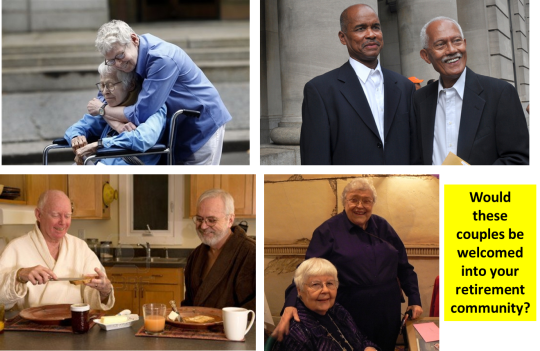
Older gay couples

Again, this blog is loaded with many useful and interesting links which I hope you will explore! (Bolded underlined)

In Part 1 of this series (link) I provided a general introduction to the topic of aging and shared some personal experiences I recently had which inspired me to write this series of blogs. Now I will write parts 2 and 3 in conjunction with the two core areas of my consulting practice – part 2 in relation to LGBT diversity and part 3 in relation to career development.

I appreciate the work of SAGE (Services and Advocacy for GLBT Elders) which provided many of the below points.
First, some general facts about the aging LGBT population:
1. It is increasing rapidly and with the shift in culture, more older LGBT people are “coming out.” Recent estimates suggest that there are over 1.5M LGBT people over 65 in the USA and that will double by the year 2030.
2. A higher percentage of LGBT elders face financial hardships due to job benefit and social security inequities, and fewer family members to help care for them.
3. LGBT elders deal with a significantly higher rate of mental and physical health disparities. 39% of LGBT elders have contemplated suicide and 53% feel isolated from others (over double the general population)
4. Many LGBT elderly people face discrimination and stigma in the lives for our country’s systems that support the aging.

Many of these issues are even amplified for the aging transgender population. Many of these issues arise from the fact that many of today’s aging services providers are ill-equipped to provide competent and nondiscriminatory services to address the unique needs to transgender elders, and some health issues remain from barriers faced to receiving quality health care earlier in their life spans.

However, I see some encouraging signs that there is much more focus now on the intersection of aging and LGBT, and this emphasis must continue to development. There are growing resources for LGBT elders and their allies through organizations such as:
SAGE (link)– Services and Advocacy for Gay, Lesbian, Bisexual & Transgender Elders. They also have many local chapters associated with local LGBT Centers.
AARP (link) – An Ally for Real Possibilities. If you do a search on their website search engine on LGBT – you will find that they produce a large number of their resources for the LGBT constituency.
Other hopeful signs I have seen recently include:
• The Carol Woods Retirement Community here in my own state of North Carolina, is a welcoming progressive community which even placed an ad recently in The Front Page, North Carolina’s LGBT bi-weekly paper.
• There was a full page ad in a recent Gay and Lesbian Review (bi-monthly magazine) for Fountaingrove Lodge, a new retirement community in California exclusively for the LGBT retirement community.

Also, the US Supreme Court Decision we have all been waiting on regarding the Defense of Marriage Act (DOMA) could have a huge impact on this discussion.

And I will close with a link to two more articles in the April 26 – May 9, 2013 issue of Qnotes – one titled “Focus on LGBT Aging Grows” and a second article focusing on the LGBT Senior Housing becoming a hot topic among advocates.

Look for part 3 about the link to career development and succession planning in July!