On Saturday I returned to the U of Chicago main campus in Hyde Park.
I kicked off
part one (link) with sharing about my fortuitous luck of having work in Chicago the week of my 40th MBA class reunion, and how much I enjoyed the various activities and the whole culture of the school. Yes,
University of Chicago Booth School of Business was indeed the right place for me – unabashedly analytic and data driven with a heart for making a positive impact on the world.
In part 1, I recounted most of the weekend activities, and in Part 2 I will summarize the three “classes” I took on Friday May 3 and Saturday May 4 with current faculty members. I loved the intellectual stimulation I received participating in these three classes … never too old to learn! And I did select classes that coincided well with my consulting areas of diversity, leadership and corporate culture:
• “Does Culture Eat Strategy for Lunch” with Professor Jim Schrager
• “Bringing Down Barriers: How to Build Relationships Despite Differences” with Professor Jane L. Risen
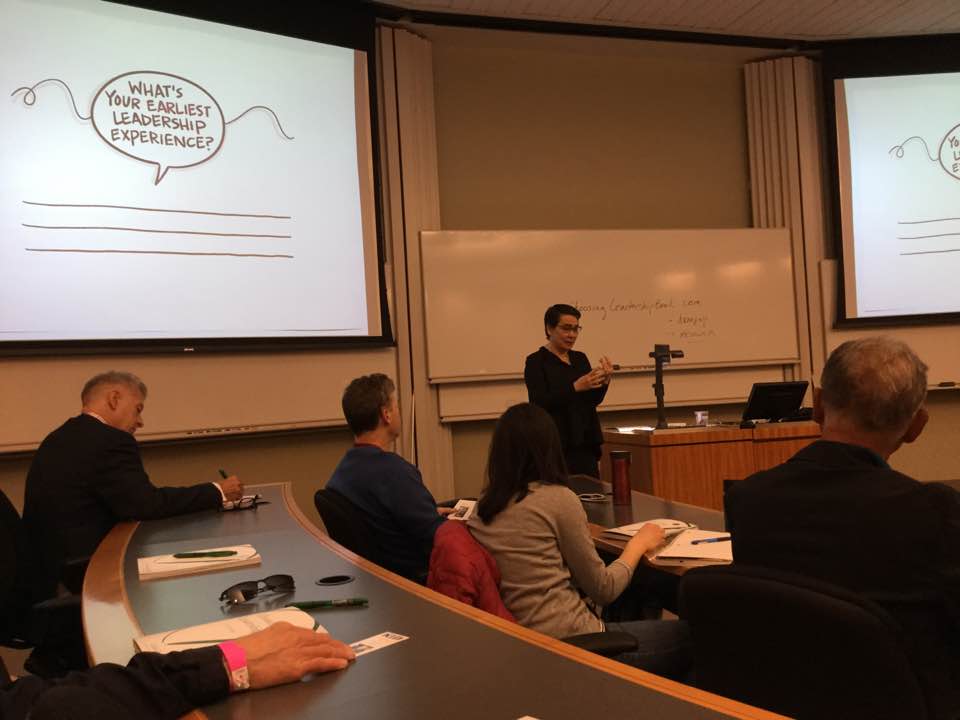
• “Choosing Leadership” with Professor Linda Ginzel

Two of the books I received during my class reunion.
In my consulting, I often do discuss corporate culture and how important that is for organizational success. But what is really more important, having a good strategy or a strong corporate culture? Professor Schrager likened this to the nature vs. nurture debate and the oft-talked about study of identical twins separated at birth.
Professor Schrager took the natural experiment approach by sharing a number of case studies that held all variables constant, but then looked at various cultures and strategies. In these case studies across multiple industries, companies that did not have strong strategies focusing on growing in a quickly changing world and market failed irregardless of their corporate culture. Yes, culture is important, and a strong culture where people will exert discretionary effort to help the organization succeed is an important factor in successful execution, but a lackluster or poor strategy will lead to failure no matter how hard everyone works.
“Bringing Down Barriers: How to Build Relationships Despite Differences” with Professor Jane L. Risen. Professor Risen started by introducing us to the term “homophily” which is “love of the same,” the natural human tendency to associate with, build relationships with, and like people similar to ourselves. But how can we deliberately build strong relationships with those different from us, which is increasingly important in our ever accelerating multicultural workplace?
She then introduced a study done over several years with a program called “Seeds of Peace” where teenagers from Israel and Palestine are brought together for a 3-week camping experience in Maine. These are two groups have that tremendous tension on the world scene, where understanding relationships are quite rare.
Extensive data analysis proved the concept of propinquity, that physical or psychological proximity facilitates relationships despite tremendous differences. There was a phenomenal statistically significant increase in close personal relationships between Israeli and Palestinian teens who either bunked together in the same cabin or participated together in long deep discussion groups. The application is that very diverse people who work together in an organization around common goals can even be more effective by building close relationships and having meaningful discussion.

Attending “Choosing Leadership” with Professor Linda Ginzel
At this session, we all got a special gift from award-winning leadership professor Linda Ginzel; her workbook “Choosing Leadership” and a green pen. (This session was on May 4th …. so link to this short cute
“May the Fourth Be With You” video from Professor Ginzel that includes an explanation of the green pen.)
Professor Ginzel first shared that Leadership is indeed hard, and she has been on a long quest to teach leadership with integrity, resulting in her developing the workbook she gave us. Then some of her additional points during this session:
• Leadership needs a structure and a framework, and we should each develop our own that suits us.
• Quote from John Gardner, “The building of community is one of the highest most essential skills a leader can command.”
• Quote from John F. Kennedy, “Leadership and Learning are indispensable to each other.”
• Each of the chapters in Professor Ginzel’s book starts with a verb since leading is active.
• Managing and Leading are both important and go hand in hand.
• Finally, Professor Ginzel’s own wonderful definition of leadership, “Behavioral choices we make in order to create a better future.”
I loved the entire stimulating weekend being at Booth Reconnect getting re-energized, meeting cool people and learning much!
* * * * *
Stan Kimer, Booth MBA ’79 retired after a 31-year career at IBM and then formed his own diversity and career development consultancy, Total Engagement Consulting by Kimer.